Posted on

Jawline Filler vs Training: What Really Changes a Jawline

WINBUILDERS | jawline contouring botox, jaw exerciser | Jawinner

There are four common ways people try to sharpen a jawline, and they do genuinely different things.
Comparing them properly makes the choice much easier.

1. Dermal filler

What it does: a gel is injected along the jaw to add volume and create a straighter,
more defined edge. It changes the outline immediately.

Lasts: typically around a year, after which it is reabsorbed and has to be repeated.

Cost: high, and recurring.

Worth knowing: it is a medical procedure with medical risks, and it adds volume rather than
removing fat. If the softness comes from fat under the chin, filler can make the lower face look fuller
rather than sharper. A good practitioner will tell you that.

2. Surgery

What it does: implants or bone surgery change the actual structure. It is the only option
that alters the skeleton.

Lasts: permanently.

Cost: the highest, with real surgical risk and recovery time.

Worth knowing: permanent also means permanent if you do not like it.

3. Losing body fat

What it does: this is the one most people underestimate. The amount of fat you carry is
usually the single biggest factor in how defined a jawline looks, and it is also the cheapest thing on this list.

Lasts: as long as you keep it off.

Worth knowing: you cannot target it. There is no exercise that burns fat specifically from
under the chin, whatever the ads say.

4. Jaw muscle training

What it does: loads the masseter so it develops, which widens and firms the jaw angle.
It changes muscle, not bone and not fat.

Lasts: as long as you keep training, like any muscle.

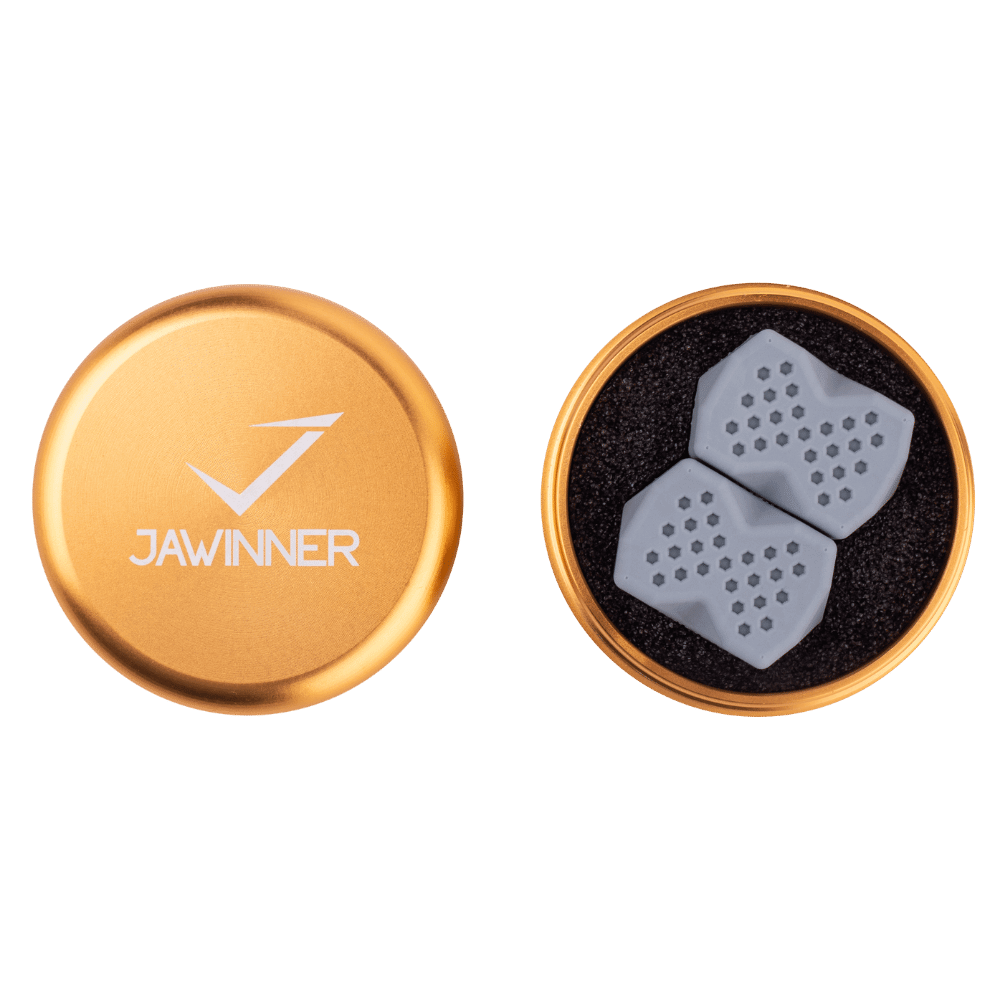
Cost: low. A firm training gum or a
silicone jaw trainer costs a fraction of one filler appointment.

Worth knowing: it is slow, the change is modest, and it is a bad idea if you have jaw joint
problems or grind your teeth. It is the lowest-risk option on this list and also the most patient one.

Which one is right

If the problem is… What actually helps
Softness from body fat Losing fat. Nothing else substitutes for it.
A narrow or undefined jaw angle Muscle training, slowly. Filler for an instant result.
The shape of the bone itself Only surgery. Be sure before you do it.
Loose skin None of the above. This is a question for a dermatologist.

The honest summary

Training is cheap, safe and slow. Filler is fast, expensive and temporary. Surgery is permanent and serious.
Fat loss underpins all of them. We sell jaw trainers, so we have an obvious interest here — which is exactly
why it is worth saying plainly that if you are carrying extra weight, training your jaw muscle will not be what
makes the difference.

If you want to start with the low-risk option, read
whether chewing gum helps a jawline first.
Posted on — Leave a comment

Mewing Before and After: What to Realistically Expect

Search for mewing before and after photos and you will find thousands of them, most of them striking.
Before you judge your own progress against those pictures, it helps to know what is actually in them.

What mewing is

Mewing means holding the whole tongue against the roof of your mouth, with the lips closed and the teeth
lightly together, as a resting posture rather than an exercise. The idea is that this constant light pressure
supports the upper jaw and encourages a more forward facial posture. We cover the technique itself in our
guide to mewing.

Why most before and after photos are misleading

Three things change between the two pictures far more often than the face does:

  • Camera angle. Shooting slightly from below instead of above transforms a jawline.
    This alone explains a large share of the photos online.
  • Body fat. Many people start mewing at the same time as going to the gym or losing weight.
    Losing facial fat sharpens a jawline much faster than tongue posture ever could.
  • Lighting and expression. Hard side lighting and a clenched jaw versus flat lighting and a
    relaxed face are not the same face photographed twice.

None of this means nothing happened. It means you cannot tell from the photo how much of it was posture.

What the evidence actually supports

This is where honesty matters more than enthusiasm. Mewing has a large following and very little formal
research behind it, and almost all the strong claims come from before and after photos rather than studies.

What is reasonably accepted: in children, whose facial bones are still developing, breathing and tongue
posture do influence how the jaw grows — that is why orthodontists care about mouth breathing. What is far
less supported: that the same posture meaningfully reshapes the bone of an adult face. In adults, the plausible
changes are smaller and softer — habitual posture, muscle tone, how you hold your head.

If anyone tells you that tongue posture will change an adult jawbone within months, treat that as marketing,
not fact.

How long people say it takes

Among people who report a change, the usual timescale is months to years of constant practice, not weeks.
It is a resting posture, so it only works if it becomes your default. Thinking about it for ten minutes a day
does nothing.

What else moves the needle

If a sharper jawline is the goal, these matter more than tongue posture for most adults:

  • Body fat. The single biggest factor in how defined any jawline looks.
  • Masseter development. The muscle at the jaw angle responds to load — see
    how the masseter works. A firm
    training gum or the Winbuilders trainer is the usual way to load it.
  • Sleep and nasal breathing. Chronic mouth breathing affects posture and facial appearance,
    and it is worth fixing for health reasons alone.
  • Posture of the head and neck. A forward head position hides a jawline instantly.

The honest summary

Mewing is free, it is not dangerous if you do it gently, and better tongue and breathing posture is
reasonable to aim for. Just do not expect your results to look like the photos. Most of those are a camera
angle and a few kilograms.

Posted on

Masseter Muscle: What It Does and How to Train It Safely

The masseter is the thick, rectangular muscle you can feel bulge on the side of your face when you clench
your teeth. It runs from your cheekbone down to the angle of your lower jaw, and for its size it is one of the
strongest muscles in the human body.

What the masseter does

Its main job is to raise the lower jaw — in other words, to close your mouth and to bite. It works alongside
the temporalis above your ear and the pterygoid muscles deeper inside. Together they handle every bite,
every chew and, for a lot of people, a great deal of unconscious clenching.

Because it sits exactly at the jaw angle, it also has a visible job. A well-developed masseter widens the
lower face and makes the jaw angle more defined. A small one leaves the jawline softer and more rounded.

Why it grows, and why that matters

The masseter is a skeletal muscle and it adapts to load like any other. The clearest proof is clinical:
people who clench or grind their teeth often develop enlarged masseters, and injecting the muscle to weaken it
is a routine way to slim a wide lower face. The same mechanism works in the other direction. Regular chewing
load is what makes it bigger.

This is why jaw training exists at all, and also why it has limits. The muscle changes. The bone it sits on
does not.

How to train it without hurting yourself

  1. Start light. If you use a training gum or a silicone trainer, begin at the softest level.
    The masseter already works at every meal, so it is easy to overload.
  2. Keep sessions short. Ten to twenty minutes a day is enough. Split it up if that is easier.
  3. Chew evenly on both sides. Favouring one side builds an asymmetry you will see in the mirror.
  4. Rest when sore. Mild soreness after a new session is normal. Pain in the joint itself is not.
  5. Give it months, not days. Muscle adaptation is slow, and the masseter is no exception.

A firm training gum keeps resistance going far longer than ordinary gum, which softens within
a minute. If you would rather not chew gum, the Winbuilders silicone trainer does the same job
with adjustable resistance.

When to leave it alone

Training the masseter is a bad idea if you have temporomandibular joint problems, if you grind your teeth at
night, if you are wearing braces, or if you already get jaw pain.
In all of those cases the muscle is usually overworked already, and adding load makes the problem worse.
Talk to a dentist first.

What it will not do

A bigger masseter widens the jaw angle. It does not remove fat under the chin, it does not tighten skin,
and it does not lengthen or reshape the jawbone. If your goal is a sharper jawline overall, muscle is one part
of it and body fat is usually the larger part. Our
complete jawline guide
covers the rest.

Posted on — Leave a comment

Does Chewing Gum Help Your Jawline? An Honest Answer

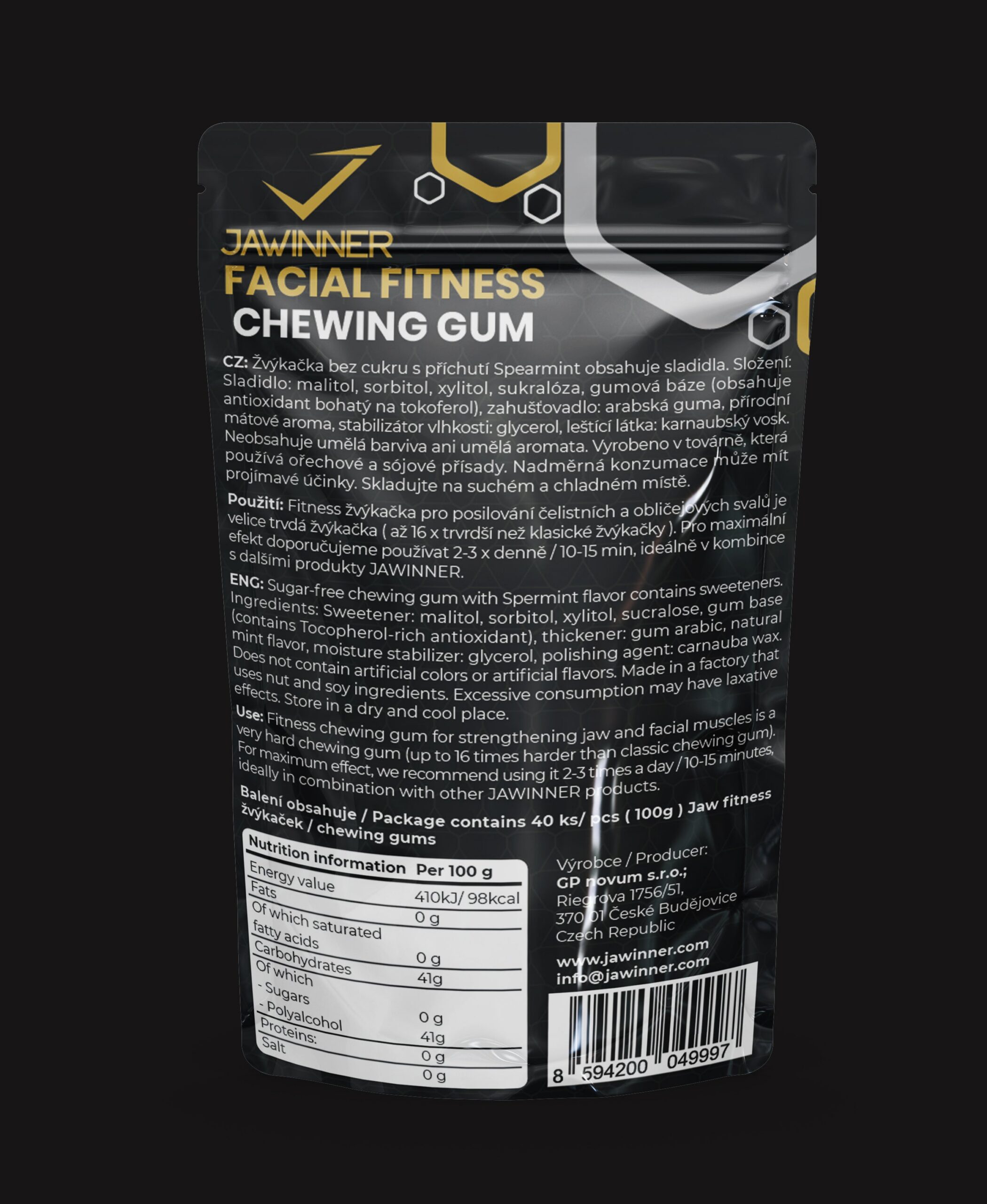
FACIAL FITNESS CHEWING GUM | Jawline Contouring | Sugar-free chewing gum

Short answer: partly. Chewing works the masseter, the thick muscle on the side of your jaw,
and muscles respond to being worked. What chewing gum cannot do is remove fat from under your chin or change
the bone underneath. If your jawline is soft because of body fat or genetics, gum alone will not fix it.

What actually happens when you chew

Every time you bite down, the masseter and the temporalis contract. They are skeletal muscles, so they follow
the same rule as any other muscle: load them regularly and they adapt and grow; stop and they shrink back.

Dentists see the extreme version of this every day. People who clench or grind their teeth at night often
develop visibly bulkier masseters, and one common treatment is to inject the muscle to weaken and slim it.
That treatment exists precisely because chewing load changes the size of the muscle. It is the clearest
real-world evidence that the mechanism works.

What chewing gum can realistically change

  • A wider, firmer-looking jaw angle. This is the part that responds. Expect a modest change,
    not a transformation.
  • Better jaw endurance. The muscle tires less easily.
  • Some posture awareness. Training the jaw makes most people more conscious of how they hold
    their mouth and tongue during the day.

What it cannot change

  • Fat under the chin. You cannot burn fat from one spot by working the muscle under it.
    A double chin responds to overall body fat, not to chewing. See our guide to
    double chin exercises for what does and does not work there.
  • Your bone structure. The shape and width of the mandible in an adult is fixed.
  • Loose skin. Muscle under loose skin does not tighten the skin itself.

Ordinary gum versus a training gum

Supermarket gum goes soft within a minute or two. After that you are barely loading the muscle at all —
it is closer to fidgeting than to training. Gum made for jaw training stays firm for far longer, which is the
whole point: the resistance has to last long enough to matter.

Hardness is usually given in durometer. Beginner gums sit around 15 and harder versions go well above that.
Starting at the hardest level is a common mistake and the fastest way to end up with a sore jaw.

Our sugar-free facial fitness gum is made for this, and the
Winbuilders jaw trainer is the silicone alternative if you prefer not to chew gum at all.

How often, and for how long

Treat it like any other muscle. Twenty minutes a day is plenty, split into shorter sessions if you like.
More is not better: the masseter is a small muscle that already works at every meal.

Visible change, if it comes, takes weeks to months, not days. Anyone promising a new jawline in two weeks
is selling you something.

When you should not do it

Stop and talk to a dentist or doctor if any of this applies:

  • You have jaw joint pain, clicking, or a diagnosis of a jaw joint
    disorder
    . Jaw training can make it worse.
  • You grind your teeth at night. Your masseter is already overworked.
  • You are in braces or other orthodontic treatment.
  • You have dental work that chewing could damage.

Mild soreness after a first session is normal, the same as after any new exercise. Sharp pain, headaches,
or a joint that clicks is not. That is the signal to stop, not to push through.

The honest summary

Chewing gum trains a real muscle and that muscle does contribute to how defined a jaw looks. It is cheap,
it is low risk if you do not overdo it, and it works slowly. It is one part of the picture — body fat, posture,
sleep and genetics are the rest. Anyone who tells you it is the whole answer is overselling it.

Posted on

How to Get a Defined Jawline: The Complete Guide

Are you looking to enhance your jawline and achieve a more defined and attractive facial structure? Look no further! In this blog post, we will explore the various options available for jawline enhancement and how they can help you achieve the desired results.

What is Jawline Enhancement?

Jawline enhancement refers to the process of improving the appearance of the jawline, making it more prominent and well-defined. A strong jawline is often associated with attractiveness and can greatly enhance one’s facial aesthetics.

Why is a Strong Jawline Desirable?

A strong jawline not only adds to the overall attractiveness of the face but also provides a more youthful appearance. It can help create a more balanced and symmetrical facial structure, enhancing the features and giving a more defined look.

Non-Surgical Jawline Enhancement Options

Not everyone is born with a naturally strong jawline, but that doesn’t mean you can’t achieve one. There are several non-surgical options available that can help enhance your jawline without the need for invasive procedures.

1. Facial Exercises: Certain exercises can help strengthen the muscles around the jawline, making it more defined and toned. These exercises target the jaw, chin, and neck muscles, providing a natural and non-invasive way to enhance the jawline.

2. Dermal Fillers: Dermal fillers are a popular non-surgical option for jawline enhancement. They can be used to add volume and definition to the jawline, creating a more sculpted and chiseled appearance. The procedure is quick, relatively painless, and requires no downtime.

3. Makeup Contouring: Makeup can work wonders in creating the illusion of a stronger jawline. By using contouring techniques, you can highlight and shadow certain areas of your face to create the desired shape and definition.

Introducing WINBUILDERS | Square Jawline, Weakest Jaw & pdo Threads Solutions

If you’re looking for a more permanent and effective solution for jawline enhancement, look no further than WINBUILDERS | Square Jawline, Weakest Jaw & pdo Threads Solutions. This innovative product is designed to provide a comprehensive solution for achieving a strong and defined jawline.

With WINBUILDERS | Square Jawline, Weakest Jaw & pdo Threads Solutions, you can say goodbye to weak jawlines and hello to a more confident and attractive appearance. This product combines the power of advanced technology and scientific research to deliver outstanding results.

Why choose WINBUILDERS | Square Jawline, Weakest Jaw & pdo Threads Solutions?

1. Effective Results: WINBUILDERS | Square Jawline, Weakest Jaw & pdo Threads Solutions has been proven to deliver effective and long-lasting results. It helps enhance the jawline, making it more prominent and defined.

2. Safe and Non-Invasive: Unlike surgical procedures, WINBUILDERS | Square Jawline, Weakest Jaw & pdo Threads Solutions is a safe and non-invasive option for jawline enhancement. It does not require any incisions or downtime, making it a convenient choice.

3. Natural-Looking Results: WINBUILDERS | Square Jawline, Weakest Jaw & pdo Threads Solutions provides natural-looking results, ensuring that your enhanced jawline blends seamlessly with your facial features.

Don’t miss out on the opportunity to achieve the jawline of your dreams! Click here to purchase WINBUILDERS | Square Jawline, Weakest Jaw & pdo Threads Solutions and take the first step towards a more confident and attractive you!

Read next: Jawline filler vs training — what really changes a jawline and does chewing gum help your jawline?

Posted on

Orthodontist on Jaw Training: An Expert View

Is the use of aids to strengthen the masticatory muscles appropriate? Orthodontist MUDr. Bernát and his opinion

MUDr. Ladislav Bernat, Ph.D. is the chief physician of the Smile Art orthodontic clinic in České Budějovice. He and his team have been specializing in the treatment and prevention of dental irregularities for more than 10 years. Patients turn to Smile Art for defects of various kinds and care is given to even the most serious cases.

We work closely with Dr. Bernát and for the purposes of today’s article, we interviewed him so that we could bring you an expert opinion on strengthening the masticatory muscles. This is an increasingly popular topic in recent years and many people are still unclear – what is the state about? Or are devices of this type a waste of money?

Orthodontic defects as a problem of civilization

Today, orthodontic defects are more common than ever before. According to surviving evidence, our ancestors had almost perfect dental health. They had regular teeth, strong jaws, and seldom had wisdom teeth problems. These are a cause for frequent concern today due to lack of space in the jaws and can distort other teeth.

A major change occurred in the Stone Age. It was people who began to use tools, to cook and thus to abandon their purely hunting-gathering tendencies. About 10,000 years ago, they also started farming, giving them easier access to food.

These factors directly caused the jaws to shrink and the masticatory muscles to weaken. Thanks to the tools created, people were able to start cutting meat into smaller pieces, so they no longer had to chew. Due to the heat treatment of food, they also began to consume a much softer diet, which accelerated this trend.

Is there a way to help the proper development of teeth?

Not only according to Mudr. Bernata, there are ways to increase the likelihood that a tooth will develop as it should. That is, without irregularities in the teeth and jaws. However, we only talk about children and adolescents here – once the teeth have completed their development, it is very difficult to reverse any defects in a natural way.

In this sense, the aids for strengthening the masticatory muscles and jaws are very suitable for parents who want to do everything to make their children achieve a more attractive smile. Keep in mind, however, that the intense development of the jaws in girls ends at most around the age of 15 and in boys around the age of 18.

Chewing aids will help the effectiveness of foil braces

Foil braces are the most popular type of braces today – they are invisible, thus eliminating any fear of the unsightly of wearing them. Instead of classic locks and wires, they use special foils that are made to measure for each patient. As a rule, we also encounter positive feedback in the sense that they can be removed at any time and their application is painless.

According to the experience of Mudr. Bernat’s chewing aids can help put the braces on and hold in place. This support element therefore speeds up the treatment and thus the straightening of the teeth. This applies to all ages. Therefore, if you wear foil braces or aligners, please note that this inexpensive and time-saving product will significantly speed up your journey to the desired smile.

Jaw strengthening supports your attractiveness

Thirdly, it is worth mentioning that the popularity of these aids has been growing in recent years, mainly due to their aesthetic benefits. When using them, the volume of the masticatory muscles increases, which is directly linked to a more attractive and trustworthy appearance.

It works just like when you strengthen any other muscle. The great advantage of this type of strengthening is the significant time efficiency. Not only can you do a lot of other activities while chewing, and therefore kill two flies with one blow, but the results are visible after only a few weeks of regular chewing.

Jawinner aids are made of non-hazardous silicone, which undergoes regular and thorough testing for safety. So you definitely don’t have to worry about any allergic reaction or side effects.

The Jawinner team is also working on several studies to look at the effect of jaw strengthening on health problems. Namely, it is mainly sleep apnea or ronchopathy or snoring. The results already look very promising, and we’ll be happy to share them with you as soon as we have more information.

Like MUDr. Bernát we believe that we have something in our hands that can improve the quality of life of any user.

Posted on

A Strong Jawline and Confidence: What Research Says

5 tips to boost confidence and well-being

Not everyone is born a confident person. Many people acquire this trait over a lifetime or even at all, usually as a result of unpleasant personal events. Fortunately, there are ways that self-confidence can make a significant contribution – and we’ll introduce some of them in the following lines.

1. Goals are the foundation

Self-confidence comes from success . If you manage to meet the short-term and long-term goals you set, you will naturally gain more confidence in your ability, and thus a way to how to increase self-confidence .

But for this to be truly effective, you need to be realistic in setting your goals . Take into account your abilities and time possibilities and do not be greedy. Sometimes it’s much better to proceed slowly but confidently than to pursue the unattainable – it could end in disappointment again.

And most importantly – don’t forget to appreciate your efforts.

Start slowly with a plan for each day, week, or month. Over time, not only will your self-confidence boost but also your ambitions and your goals will grow naturally with you.

2. Follow your principles

Most confident people have a system of values ​​by which they act and make decisions regardless on circumstances . Although it is sometimes difficult and not in their personal interest, higher priority and integrity are always a priority for them.

The next time you make a decision – and it doesn’t have to be a difficult life issue ask yourself what your best version you want to do would do, and do it .

Although sometimes you have to sacrifice your own interests, in the long run with you you will be happier and may even become proud of yourself which will bring you to the natural boosting self-confidence .

3. Start exercising regularly

In addition to supporting your health, exercise can be an interesting way how to increase your confidence . Not only will you gain more confidence in your body through movement, but it will also relieve you of stress and anxiety, and thus the fear of your own mistakes .

But you don’t have to focus only on classic games. A great effect on boosting self-confidence can also have exercise jaws using chewing aids z our offer .

Regular chewing strengthens and emphasizes the facial muscles. This gives you sharper features that give people not only a more attractive but more confident look . This may seem like a trifle, but it can be a significant step on your path to greater confidence.

4. Rethink your circle of friends

You can try a variety of ways how to increase self-confidence but if the neighborhood is constantly undermining you, the journey will be much more difficult and longer for you.

So try to notice what kind of people you are around . Do they support you and accept who you are? Or, on the contrary, do they constantly judge you and have a problem with you every time your actions do not suit their ideas?

The people you spend time with affect your thoughts and relationship much more than you think. If you feel bad after meeting your friends, it may be time to say goodbye to them , or at least significantly reduce the time you spend you spend them.

5. Do things you enjoy

Life isn’t just about making mistakes and chasing success. We also need to experience joy that makes sense in our lives and motivates us to perform in areas that are not so pleasing to us .

So don’t forget to devote part of your time to yourself and the activities you enjoy. They will help you recharge your flashlights, so you will have less tendency to worry about your own mistakes. This will mean for you not only boosting self-confidence , but also a happier and happier life .

Posted on

Jaw Exercises: How to Train Your Jaw Muscles

What exactly is it?

More and more people are interested in a healthy lifestyle and exercise. But did you know that weight training doesn’t just apply to standardly trained body parts, but also to the jaws?

When you type anything into your search engine that has to do with strengthening your jaws, tens of thousands of results will come up. And expect the available information on this topic to increase, as the practice’s popularity continues to grow today. You can then come across hundreds of “before and after” changes on social networks. There is a documented procedure for a marked jaw enhancement, which users achieved relatively easily.

How?

There are more options.


Mewing – jaw cradle

It is not entirely clear when the interest in strengthening the jaws was born. However, many experts map it to the 1970s, when orthodontist John Mew created the mewing technique. It basically involves systematically placing the tongue on the floor and other parts of the mouth – and according to John and his fans, it can bring a lot of aesthetic and health benefits.

And because our jaws are smaller today than our ancestors had, we have less room for teeth, which then deform. This factor also contributes to the fact that our faces are not as aesthetically pleasing as they could be. Most importantly, however, according to Mew, this practice can also help fight sleep apnea and promote a healthy respiratory system.

In addition to mewing, more and more practices have emerged over the years that can help us strengthen our jaws. These exercises then focus mainly on the aesthetic nature of the thing – and in addition to getting a more pronounced jaw line, you can also help from the sagging corners, second chin or weak faces.

This effect then also manifests itself in the person’s self-confidence, which increases. Outlined facial features have been shown to make a significant contribution to the attractiveness and credibility of individuals. They can then logically make a more convincing impression.

Just look at world celebrities! Surely you know names like Angelina Jolie, Brad Pitt, David Beckham, Jennifer Lopez and Johnny Depp – and do you know what they have in common? Outlined and distinctive jaws!


Winbuilders: a new product for boosting health and confidence

Nowadays, an even more accessible and simpler way to achieve healthier jaws and more authoritative visages has appeared on the market. These are Winbuilders chewing aids. They are made of non-hazardous silicone and regularly undergo rigorous safety testing.

You can think of Winbuilders as dumbbells for your jaws. They are more of a burden on the jaw muscles than ordinary chewing gum, and they can be used over and over again, so they only mean a one-time investment for you.

They come in three different colors that correspond to specific hardnesses:

  • White (30 Sh) – for beginners,
  • Gray (40 Sh) – Intermediate,
  • Black (50 Sh) – Advanced.

And how can you strengthen your masticatory muscles and therefore your jaws with them? Again, there are more ways and it’s up to you to decide. In the final, it is best to try them all and, over time, find out which one best suits your needs and time possibilities.

Jawinner recommends using two aids on the lower chairs at the same time so that the curved part with the holes faces the biting surface of the teeth. The aids then need to be placed at the same level on the left and right sides to avoid uneven muscle loading.

Then just bite and let go. Then repeat this step over and over for 1-2 minutes 3 × 5 to 5 × daily. The first visible results can then be seen after about two weeks.

And it’s not just about how you look, it’s about how you feel. Give your jaw strengthening a few weeks and you will see yourself in the mirror in a whole new light. You will gain the confidence you have always dreamed of, which will give new life to your life.

Read next: The masseter muscle — what it does and how to train it safely.

Posted on

Drooping Mouth Corners: Exercises That Help

Exercise against hanging corners – can it really work?

When it comes to achieving an attractive and youthful look, most people focus primarily on smoothing wrinkles, even at the expense of other, often more significant shortcomings such as hanging corners .

The mouth and especially the corners themselves The corners are among the parts of the face that best express our mood . The sagging corners of the mouth make one look annoyed and frowning, even when in fact, he doesn’t even feel it.

It is common knowledge that smiling people look young and likeable . Even though you often smile, sagging corners can make your neutral expression frown without any control over it.


Frequent frowning is not the reason

“Don’t worry, or you’ll be left with it!” even in adulthood. However, the truth is that drooping corners of the mouth are not the result of our sad and annoying grimaces , whether we are they showed them around as often as they were.

The facial expressions of our face depend on the facial muscles. We use some of them more often, others less so, so that certain muscle tissues weaken, while others strengthen . Over time, this creates a specific neutral expression on our face.

In addition, the function of the sebaceous glands and the blood circulation in our face decreases with age. The skin is then less hydrated and nourished, so it has a greater tendency to gravity and sag , causing problems such as just hanging corners , does not add too much.

But what to do to strengthen the facial muscles and thus also remove hanging corners ? Let’s imagine a few practices that you can do yourself at home.


Chewing to remove sagging corners

Before we reveal specific exercises on drooping corners of the mouth , we must imagine a much simpler and time-saving activity that effectively strengthens the facial muscles, not only in the area around the mouth – chewing.

You can use classic chewing gum at the beginning. However, if you don’t like them or don’t want to spend time on them all the time, we have a more sustainable solution for you – our chewing aids .

These are reusable, tasteless chewing gums that are harder but allow for more intense muscle engagement. They come in a handy case, so you can take them with you virtually anywhere and work to remove sagging corners during various activities < span style = "font-weight: 400;"> – whether at the computer, behind the wheel or in public transport.

Just twenty minutes a day and after a few weeks you will see a visible difference .


4 effective sag corner exercises

If you feel that chewing is not enough and you want against your hanging corners do something extra, you can also try the following exercises. They are easy, time-saving and time-consuming no special utilities .

  1. Round your lips as hard as you would like to say the letter “O” and release again after a few seconds. Repeat the exercise at least 15-20 times.
  2. Relax your face as much as possible, then smile convulsively and hold this position for a few seconds. Then relax the muscles again and repeat the whole exercise 15-20 times.
  3. Take a pencil or a thicker straw and put it in your mouth as if you wanted to drink. Then move your mouth and surrounding muscles as if you were painting an imaginary geometric shape with a straw or pencil – a square, a circle or an figure of eight.
  4. Smile, put your fingers to the corners of your mouth and gently stretch your muscles to the sides. Hold the position for 10 to 20 seconds, then release.

Even if you do facial muscle strengthening every day, be sure to hanging corners does not disappear from day to day. It takes time and, most importantly, patience to strengthen every muscle. If you lack motivation, take a picture of your face every day and compare them with each other after a while – even a little progress so it will be much more visible than when looking in a mirror every day.

Posted on

Mewing: What It Is and Does It Really Work?

A popular practice called mewing – what is it and what benefits can it bring?

People come up with a lot of practices, which have the potential to strengthen their health in any way and ideally also to improve their appearance. One such technique is mewing which is a big hit in many foreign countries, but is still coming to us .

Mewing technique consists in consciously holding the tongue in a certain position, which should result in the shaping of the jaw and face .

Science on effects mewing has not focused much yet and therefore could not confirm them. However, if you look at social networks, YouTube, or discussion forums like Reddit, you’ll see a lot of positive feedback.

For many people, mewing technique has become not only a tool to improve the aesthetics of their face, but also to address health complications such as sleep apnea or frequent inflammation dutin .


Inspiration from the work of a British Orthodontist

For the author mewing is considered a British orthodontist John Mew. Together with his son Michael Mew, who works in the same field, he promotes a form of orthodontics called “orthotropics” that focuses on jaw holding – inter alia by changing the location of the language.

People caught on to the principles of orthotropics and named the practice after the doctor’s surnames they inspired mewing . While John Mew himself came up with this series of techniques to help children whose jaw is still in development , today it is used by hundreds of thousands adults to improve their image.


Mewing step by step

Implementation mewing techniques is extremely simple and requires no utilities. Of course, each guide is a little different, but the basic procedure is as follows:

  • Close your mouth.
  • Put your lower jaw in such a position that your lower front teeth are just behind the upper ones. 
  • Stick the whole tongue on the floor so that its tip is just behind the front teeth but does not touch them at the same time.
  • Perform this technique whenever you remember – the goal is to make this position a natural, resting position in your mouth. 

A lot of people have actually confirmed beneficial effects mewing both aesthetically and medically – most often they improved sleep apnea, difficulty breathing and swallowing, speech disorders, temporomandibular joint dysfunction or sinusitis.

However, this is a relatively new and unexplored practice and should be approached with caution. The main risks, usually associated with poor execution mewing , include tooth and jaw displacement, temporomandibular joint pain, and tooth damage .


Jaw strengthening alternatives

If you are looking for ways to promote jaw health and achieve an attractive appearance, mewing technique may not be the only way for you.

Ordinary chewing can also help, especially if you use our special tools. Their hardness is optimal for a really effective involvement of the masticatory muscles, which strengthens them, and thus tones the features of the face . In addition, they are reusable and therefore represent a one-off investment.

Whatever you decide to try mewing or another technique, if you are in the care of an orthodontist or similar specialist, it is always better to consult with him about your intention so as not to disrupt your current treatment.

Read next: Mewing before and after — what to realistically expect.