
Short answer: partly. Chewing works the masseter, the thick muscle on the side of your jaw,
and muscles respond to being worked. What chewing gum cannot do is remove fat from under your chin or change
the bone underneath. If your jawline is soft because of body fat or genetics, gum alone will not fix it.
What actually happens when you chew
Every time you bite down, the masseter and the temporalis contract. They are skeletal muscles, so they follow
the same rule as any other muscle: load them regularly and they adapt and grow; stop and they shrink back.
Dentists see the extreme version of this every day. People who clench or grind their teeth at night often
develop visibly bulkier masseters, and one common treatment is to inject the muscle to weaken and slim it.
That treatment exists precisely because chewing load changes the size of the muscle. It is the clearest
real-world evidence that the mechanism works.
What chewing gum can realistically change
- A wider, firmer-looking jaw angle. This is the part that responds. Expect a modest change,
not a transformation. - Better jaw endurance. The muscle tires less easily.
- Some posture awareness. Training the jaw makes most people more conscious of how they hold
their mouth and tongue during the day.
What it cannot change
- Fat under the chin. You cannot burn fat from one spot by working the muscle under it.
A double chin responds to overall body fat, not to chewing. See our guide to
double chin exercises for what does and does not work there. - Your bone structure. The shape and width of the mandible in an adult is fixed.
- Loose skin. Muscle under loose skin does not tighten the skin itself.
Ordinary gum versus a training gum
Supermarket gum goes soft within a minute or two. After that you are barely loading the muscle at all —
it is closer to fidgeting than to training. Gum made for jaw training stays firm for far longer, which is the
whole point: the resistance has to last long enough to matter.
Hardness is usually given in durometer. Beginner gums sit around 15 and harder versions go well above that.
Starting at the hardest level is a common mistake and the fastest way to end up with a sore jaw.
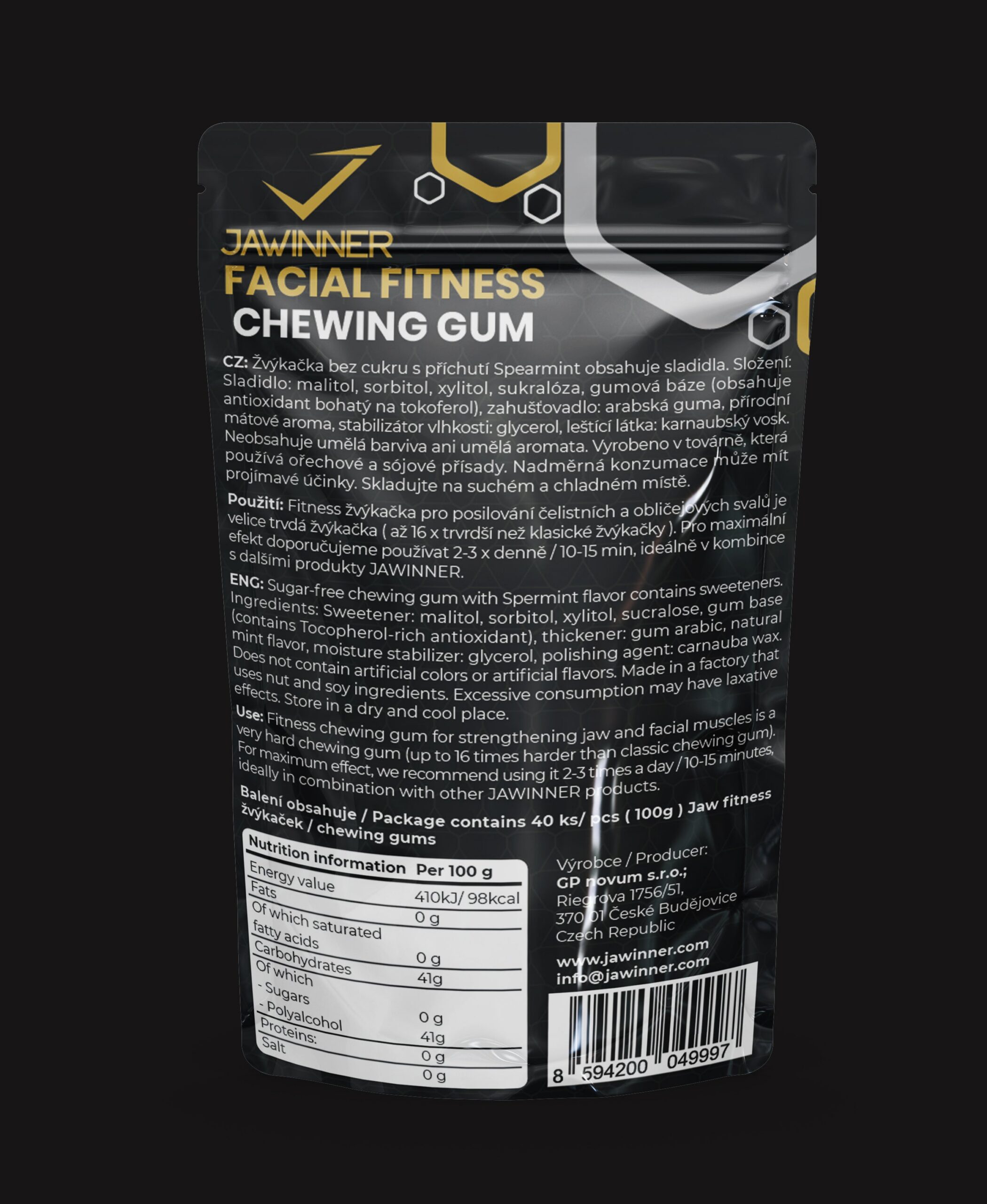
Our sugar-free facial fitness gum is made for this, and the
Winbuilders jaw trainer is the silicone alternative if you prefer not to chew gum at all.
How often, and for how long
Treat it like any other muscle. Twenty minutes a day is plenty, split into shorter sessions if you like.
More is not better: the masseter is a small muscle that already works at every meal.
Visible change, if it comes, takes weeks to months, not days. Anyone promising a new jawline in two weeks
is selling you something.
When you should not do it
Stop and talk to a dentist or doctor if any of this applies:
- You have jaw joint pain, clicking, or a diagnosis of a jaw joint
disorder. Jaw training can make it worse. - You grind your teeth at night. Your masseter is already overworked.
- You are in braces or other orthodontic treatment.
- You have dental work that chewing could damage.
Mild soreness after a first session is normal, the same as after any new exercise. Sharp pain, headaches,
or a joint that clicks is not. That is the signal to stop, not to push through.
The honest summary
Chewing gum trains a real muscle and that muscle does contribute to how defined a jaw looks. It is cheap,
it is low risk if you do not overdo it, and it works slowly. It is one part of the picture — body fat, posture,
sleep and genetics are the rest. Anyone who tells you it is the whole answer is overselling it.